Friday, February 15, 2013

Eeyore's Writing Meter


"This writing business--pencils and what-not--is overrated. Silly stuff. Nothing in it." 
                                                                                       --Eeyore, from A.A. Milne's Winnie-the-Pooh

Where did the needle for the Eeyore writing-meter register for you this week, with a tilt toward gloomy or sunny? Mine? Mostly sunny but with a few (plot) clouds. But, like Eeyore also says, "One can't complain. I have my friends. Somebody spoke to me only yesterday."

Wishing you more sunshine than not in your corner of the writing world. Happy weekend!
___________________________________

Friday, February 8, 2013

(Brain) Food For Thought

"It's hard not to multitask, given all the things we have to do and all the streams of information coming at us non-stop."--Douglas Merrill

photo courtesy microsoft office clipart
Multitasking. A word that's been around for some time, and one that expresses our sometimes-frenzied culture. There's never enough time, especially in this intense information age, so gotta' do several things at once or we won't get everything done, right?

Maybe wrong.

Multitasking (n.): "the performance of multiple tasks at one time." (Merriam Webster).

I hadn't given much thought to this concept until a recent health newsletter came in the mail. The headline announced, Stop Multitasking to Improve Your Memory (Life Advice, Winter 2013).

In it, results of studies conducted by Dr.Gary Small, director of the UCLA Longevity Center and author of The Alzheimer's Prevention Program, were summed up. "A good memory requires focusing attention and getting information into memory stores so it can be retrieved later. When multitasking--switching from phone to computer to TV--information doesn't stay in the brain long enough to be retained." He also says that the belief that multitasking helps get more done is a fallacy. "Multitasking makes people sloppy and error-prone. Do one thing at a time and your memory will improve."

Turns out this has been a subject that's been studied and bandied about for some time. Titles of a variety of blog posts--and sound bites extracted from them--tell quite a story:

The Myth of Multitasking, Tyler Falk. "A new study from the University of Utah calls out all the self-proclaimed multitaskers out there. The take away? You're not as good at multitasking as you think you are."

Why Multitasking Doesn't Work, Douglas Merrill. "I know, you think you're good at multitasking. And to some degree, you are. You can walk and chew gum at the same time. Folding laundry while talking on the phone? Not a problem...This form of multitasking works because these are rote tasks that don't require much brainpower. Unfortunately, our brains just aren't equipped for multitasking tasks that do require brainpower...When you're trying to accomplish two dissimilar tasks, each one requiring some level of consideration and attention, multitasking falls apart. Your brain just can't take in and process two simultaneous, separate streams of information and encode them fully into short-term memory. When information doesn't make it into short-term memory, it can't be transferred into long-term memory for later recall...Instead of actually helping you, multitasking works against you. It's making you less efficient, not more."

Is Multitasking Bad for Us?, Brandon Keim. "It is sometimes argued that multitasking is nothing new. For more than half a century, people grew up talking on the phone while watching TV, doing homework while listening to music, and so on. The multiple, ubiquitous information streams of early-21st-century life, however, are different in kind rather than degree. If we used to ride a cognitive horse-and-buggy, now we're in a race car." Also, from a study Keim quotes, "High multitaskers were bad at filtering irrelevant information from relevant, something that, one might suppose, a multitasker should be especially good at. High multitaskers also had diminished powers of mental organization and extra difficulty switching between tasks."

The Cognitive Costs of Multitasking, Kendra Cherry. "Recent research...has demonstrated that switching from one task to the next takes a serious toll on productivity. Multitaskers have more trouble tuning out distractions than people who focus on one task at a time. Also, doing different things at once can actually impair cognitive ability." Cherry goes on to give a three-part definition on what multitasking can mean: 1. performing two or more tasks simultaneously, 2. switching back and forth from one thing to another, 3. performing a number of tasks in rapid succession.

Multitasking is Making You Stupid, Jessica Stillman. "Doing many things at once isn't just distracting--it actually takes points off your IQ, scientists say...'A study done at the University of London found that constant emailing and text-messaging reduces mental capability by an average of 10 points on an IQ test...This effect is similar to missing a night's sleep.'"

Ouch. Where do those of us who multitask on a regular basis go with information like this? Can we slow down and give full attention to the task at hand? Can we prioritize? Can we be more productive, more nurturing, more engaged in the moment? Is there a counter to the debate that says multitasking isn't so bad? Should the word "balance" be introduced to the discussion?

What about you? Do you multitask regularly? What is your definition of multitasking? Has your productivity benefited or suffered? How well is your brainpower functioning?

Just some (brain) food for thought...
_____________________________________

Wednesday, January 30, 2013

Description: Looking Through a Different Lens


"You can take for granted that people know more or less what a street, a shop, a beach, a sky, an oak tree look like. Tell them what makes this one different." --Neil Gaiman

Just dropping in with a quote and a writing link with great advice that I came across this week: 5 Ways into a Story, by Quinn Dalton at Writer Magazine. Quinn writes about, among other things, finding the character, listening to voice, and following the image. Lots of good stuff to think about.

Enjoy!
_________________________ 

Wednesday, January 23, 2013

Progress: Inch-by-Inch

"All I know is that if I sit there long enough, something will happen." --Anne Lamott, Bird by Bird


Starting a new project often stirs up trepidation in a writer. Doubts arise, negatives nag, the blank page looks so...well, empty. Where's the joy, the anticipation--the discovery?

The answer lies in taking it an inch at a time. And literally using a one-inch picture frame as a reminder. This is another gem of an idea from Anne Lamott in her book Bird by Bird.

"What I do at this point," she writes, "as the panic mounts and the jungle drums begin beating and I realize that the well has run dry and that my future is behind me and I'm going to have to get a job only I'm completely unemployable, is to stop. First I try to breathe...and I finally notice the one-inch picture frame that I put on my desk to remind me of short assignments.

"It reminds me that all I have to do is write down as much as I can see through a one-inch picture frame. This is all I have to bite off for the time being....after I've completely exhausted myself, I remember to pick up the one-inch piece of my story to tell, one small scene, one memory, one exchange...finish this one short assignment."

I'm taking this advice to heart and now have my own one-inch frame close by to remind me. Go away, nags and doubts. I have a plan. All I have to do is think small assignment and concentrate in the moment on it.

What's your plan to stick to your project until its completion? Any tricks up your sleeve, or inch-by-inch secrets?
_______________________________

Wednesday, January 16, 2013

Mid-Week Inspiration


"A story isn't about a moment in time, a story is about the moment in time." --W.D. Wetherell

Managing to meet some word count goals this week--cheers for hitting a target for new words not just rearranging old ones! But I'm still searching for the moment in time in my new WIP. How about you? How are writerly things and new year's targets looking over your way this week?
______________________________

Saturday, January 12, 2013

Broccoli and Intuition

"Trust your hunches. They're usually based on facts filed away just below the conscious level." 
                                                                                                                 --Joyce Brothers

photo: scx.hu
A group of us friends get together periodically for a meal and movie, hosting in our homes in turn. We've done this for so long, toddlers have grown up and gotten married. Sometime ago we decided to do themed dinners--starting with international meals where everyone brought a dish linked to a chosen country. From that idea we moved to more unusual themes. For example, for this last get-together our hostess emailed: "It's the middle of winter, and we need a little sunshine. Let's do 'lemon and lime.'"

For my part I researched and came up with an elaborate recipe called "lemon spaghetti." It involved said spaghetti, steamed broccoli, carrots, and red bell peppers, and a lemon-yogurt dressing. And then I came down with a nasty head cold. My instincts told me I was not going to be able to go, let alone make this dish.

Hubby (who was not sick) stepped up. "Can I adapt the recipe, make something easy?" he asked. "That way I can take a dish when I go." We settled on steamed broccoli with sauteed garlic and a splash of lemon juice. Sufficient for the occasion and, it turns out, well received.

I only share this because the incident reminded me of a favorite passage from Anne Lamott's popular book on writing, Bird by Bird, in the chapter called (fittingly), "Broccoli." 

She writes: "There's an old Mel  Brooks routine...where the psychiatrist tells his patient, 'Listen to your broccoli, and your broccoli will tell you how to eat it.' And when I first tell my students this, they look at me as if things have clearly begun to deteriorate. But it is as important a concept in writing as it is in real life. It means, of course, that when you don't know what to do, when you don't know whether your character would do this or that, you get quiet and try to hear that still small voice inside. It will tell you what to do..."

In other words, rely on your "intuition."

Intuition (n.)--"the act or faculty of knowing or sensing without the use of rational processes; a perceptive insight."

Ms. Lamott goes on to say that intuition, however, won't kick in if we quit too soon. You sit down, she says, at say 9:15 a.m. and you only have your rational mind to guide you. Then, if you're having a bad day, you crash and burn within a half hour and give up. But "if you stick it out, the image or situation might come to you that would wedge the door open for a character, after which you would only have to get out of the way. Because then the character could come forward and speak and might say something important...and your plot might suddenly fall into place."

"You get your confidence and intuition back," she adds, "by trusting yourself. You get your intuition back when you make space for it...You might have to coax it (since intuition is "a little shy")...(but) try to calm down, get quiet, breathe, and listen...Train yourself to hear that small inner voice."

Tips then on tapping into our intuition:
Stay in chair.
Don't quit.
Stick it out.
Trust yourself.
Make space.
Get quiet.
Breathe.
Listen.

And, in conclusion, "Listen to your broccoli. Maybe it will know what to do. Then, if you've worked in good faith for a couple of hours but cannot hear it today, have some lunch."

Ha. Did you know you could learn so much about writing by embracing a hunk of broccoli? How much do you depend on intuition in your writing? Have you consciously tried to train yourself to hear that small inner voice? Have you given your intuition a name?

Next assignment: Name your intuition, and tell us why that name "speaks" to you!
_________________________

Monday, January 7, 2013

Potential

"We spend January 1 walking through our lives, room by room, drawing up a list of work to be done, cracks to be patched. Maybe this year, to balance the list, we ought to walk through the rooms of our lives, not looking for flaws, but for potential." --Ellen Goodman

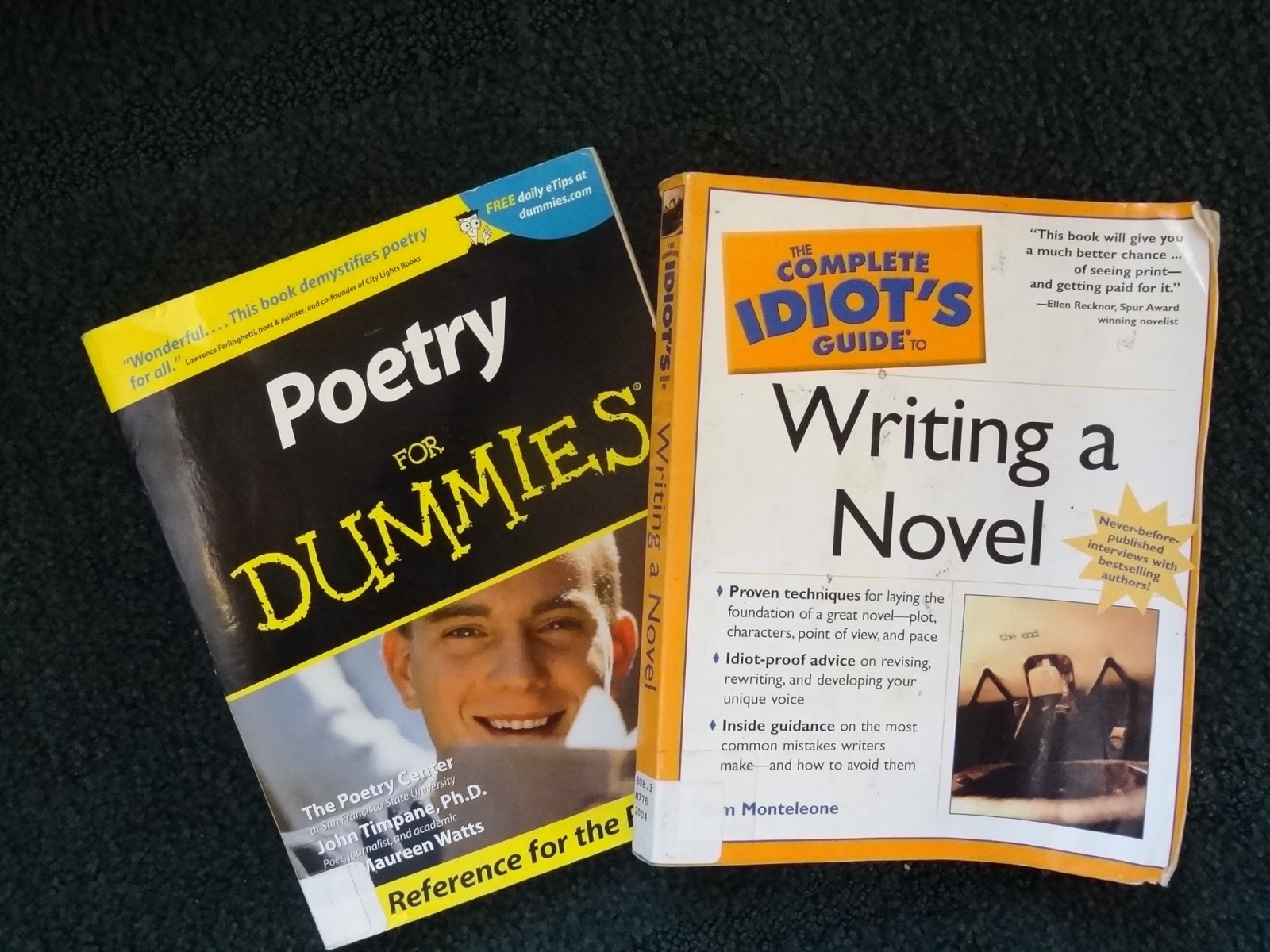
My first visit to the local library in the new year, and what books did I come home with? These two titles jumped out at me and found their way into my take-home pile:


The Complete Idiot's Guide to Writing a Novel? Poetry for Dummies? I think these spoke to me because they announce there's potential in each writer, no matter what level we're at. Potential is my writing word for the upcoming year. And I'm open to inspiration wherever I can find it!

I'm also revisiting my "target" idea that I've adhered to the last two years, the concentric ring concept of a writer's bulls-eye that I posted about here. It's proved to be such a successful tool for getting more words down on paper than not (increasing from 71% of hitting a target the first year to 79% this past year!) that I'm returning to it in the new year.

My photo-a-day challenge came to a close December 31. In it's place I've set a higher word-count goal as the new year's challenge (so many writing ideas are begging for attention)--and to a more expanded exploration of poetry. The little bit of poetry that I dabbled in last year (especially haiku, talked about here) has inspired me to go a little deeper and see what potential a new writing form carries.

With all of this I've also determined to give myself permission. Permission to find patterns that work for me, a pace that's manageable, and priorities that are balanced.

Permission. Pace. Priorities. A tall order--but one with possibility, promise, potential.

How about you? What books are on the top of your reading pile for the new year? And how do you hope to unlock the potential that is within your grasp?

p.s. a helpful post on the subject of writing routines for the new year and finding a balance can be found over at Elizabeth Spann Craig's Mystery Writing Is Murder where Elizabeth Grace Saunders, author of The 3 Secrets to Effective Time Investment: How to Achieve More Success with Less Stress,  has written a guest post on "More Time to Write in 2013." 
___________________________