Friday, November 22, 2013

10 Branches of Narrative's Tree

image courtesy of sxc.hu
“If in the first chapter a hurricane is going to blow down an oak tree which falls through the kitchen roof, there's no need to first describe the kitchen.”— James Thayer

Narrative, simply put, is story--the trunk of the writer's work. For some reason, I got to thinking about this word the other day and decided to check it out--explore the word's roots and see where such an adventure might take me. I found myself climbing branch to branch, ten in all:

1. Narrate: to tell the story of (from the Latin narrare relate).

2. Narration: the act of telling a story.

3. Narrator: a person who tells a story.

4. Narrative Arc: the structure of story. This is often described as that of a three-act play--a beginning, a middle, and an end. Narrative arc is also often pictured as a bell curve: "It starts at a point on the lower left hand side of a graph, rises in a curve to a peak, and then drops back down again." (Robb Grindstaff). In this image the story is shown progressing from introduction and setting of the stage (beginning) through conflict and complications (middle) to the story's climax, denouement, and resolution. This is also referred to as narrative structure.

5. Narrative Authority: grounding the character in authenticity and context. Nancy Lamb in her book, The Art and Craft of Storytelling, calls this anchoring. Anchor your character in time and place, she says, otherwise they won't be able to come to life. Research for authenticity. Employ the use of all five senses. Know your setting. Things like that.

6. Narrative Continuity: orienting the reader in time and space. Lamb addresses this as well: "Whatever strategy you use to increase suspense, always remember to maintain the narrative continuity of your story by orienting the reader in time and space. When you reconnect with the main plot, include a prompt about where you are." Lamb's example is a character named Lia who is on a ladder. While there she has a flashback. But the author doesn't leave her there. Lia then "grips" the ladder, bringing her back to the reader's present.

7. Narrative Threads: the storyline or, in other words, plot threads. "A narrative thread (Wikipedia) refers to particular elements and techniques of writing to center the story in the action or experience of characters. The narrative threads experienced by different but specific characters are those seen in the eyes of those characters...each thread of which is woven together by the writer to create a work." Lamb weighs in here, too. "If yours is a book," she says, "that has required lots of research, make certain your story doesn't take a back seat to the facts and figures you include. Otherwise your narrative threads will be overwhelmed by details and your story will be lost along with your reader."

8. Narrative Voice: your natural tendencies in storytelling. This definition comes from Joseph Bates in his book The Nighttime Novelist, quoted by Roseann Biederman in the Writer's Digest article, "How to Find Your Narrative Voice." In the article Biederman says, "A strong narrative voice gives your fiction a distinctive flavor and makes it stand out in a slush pile. But many beginning novelists struggle with finding their narrative voice." She continues by quoting Bates, "You may already have an understanding of your natural tendencies in storytelling; if so, wonderful. But if not, let me reassure you that those tendencies are there, that your own voice is waiting, and wanting, to emerge...(but) it's a process of trial and error. Write without overthinking what happens, and take note of what patterns you see emerge in your work that might suggest your natural strengths in voice."

9. Narrative Clutter: too much detail resulting in confusion for the reader. Ansen Dibell in his book Plot makes some good points on this subject. For example, "Don't mention the names of any characters who aren't vital to the scene or to the scene immediately following. Develop or introduce extra characters later, when the context calls for them and they have something to do. Don't have your entire cast of characters, and all their relationships, cluttering the narrative at the beginning."

10. Narrative Roots: writing from what you know, from where you come, and what you feel. "It is by the nature of itself that fiction is all bound up in the local," said Eudora Welty. "The internal reason for that is surely that feelings are bound up in place...Fiction depends for its life on place."

I'm sure there are many branches of Narrative's Tree I missed. Are there any you've explored, any you've swung from--or fallen out of? (!)
_____________________________

Tuesday, November 12, 2013

Forks in a Writer's Road

Abandoned bike seen on walk, November 2013
"I've always been interested in medicine and was pleased when my brother became a doctor. But after thinking seriously about that field, I realized that what intrigued me was not the science, not the chemistry or biology of medicine, but the narrative--the story of each patient, each illness. --Lois Lowry

I saw this bicycle one day last week while on my walk, and got to wondering about the paths the old bike might have been down, the stories it could tell. Who were its riders who might have felt breezes blow their hair while coasting downhill or gasped for breath going uphill? What forks in the road challenged them to explore--or change direction?

Newbery Award winner Lois Lowry (Number the Stars and The Giver) says she was drawn to writing because of people's stories. But first she considered entering the medical field. Interesting background on a talented writer (she's written over 30 books) showing the fork in the road she faced.

Lowry has also written about how she became a writer: "I was a solitary child, born in the middle of three, who lived in the world of books and my own imagination. There are some children, and I was this kind of child, who are introverts and love to read--who prefer to curl up with a book than to hang out with friends or play at the ball field. Children like that begin to develop a feeling for language and for story. And that was true for me--that's how I became a writer."

How did you become a writer? Did your life's goal start out one way only to change direction? Did you encounter a fork in the road, or did you hop on an imaginary bicycle, close your eyes, and pedal furiously down the road of surprise?

Hmmm, not such a bad idea. Except that maybe we should keep our eyes open...?

______________________________

Tuesday, November 5, 2013

Announcement: Free Critique Giveaway


Chasing ducks at the park, November 2013
Looking for a chance to chase your (writing) dreams? Dear Editor is offering a giveaway that just might get you a little closer!

In celebration of meeting her deadline for the first half of her new craft book, Writing the New Adult Novel: How to Write & Sell 'New Adult' Fiction, Dear Editor is giving away a free critique of the first 10 pages of your fiction manuscript. Entry deadline: November 7, 2013.

Though the deadline is nearing, there's still plenty of time. You qualify if your manuscript is fiction in any genre--adult, new adult, YA, MG. No children's picture books, though. The winner will be randomly selected and announced on November 8, 2013.

Dear Editor explains the critique: "In a critique the author receives general feedback about the manuscript sample's overall pacing, organization, narrative voice, characterization, point of view, setting, delivery of background information, adult sensibility (children's books only), concept, and the synchronicity of age-appropriate subject matter with target audience. It is not a word-by-word, line-by-line 'line edit.'"

Pretty neat, huh? Well then, if interested, hop on over to Dear Editor (here) where you'll find details on how to enter--and incentives to spread the word.

Chasing dreams and/or ducks--it's all a matter of getting closer to the goal, right?
_____________________________

Thursday, October 31, 2013

Reflecting: Mirrors and Character

View from a downtown Cincinnati street, October 2013

                        "A writer can never know about a character's feelings what is 
                         not somewhere mirrored in her own." --Katherine Paterson

Been reflecting on this thought here of late...

Any writing subject in particular you've been pondering?
                                                ________________________________ 

Sunday, October 27, 2013

A Writer's Postage Stamp


"I was trying to talk about people, using the only tool I knew, which was the country that I knew...I discovered that my own little postage stamp of native soil was worth writing about and that I would never live long enough to exhaust it." --William Faulkner

Hubby and I participated in our second-ever 5K Volksmarch yesterday (last year's here), a "German-style walk" hosted by the local German Society in our area. A volksmarch is defined as "a people's march," a non-competitive leisurely walk along a marked trail. The goal of a volksmarch? "To develop physical fitness and good health and enjoy the camraderie of fellow walkers." We can attest to that--it was great fun, and the German food afterwards delicious! And in talking with my brother after the fact, I found out that years ago he participated in volksmarches where they originated--in Germany itself. He was stationed in the army there at the time and recalls great memories of the native soil he strolled through.

Do you agree with Mr. Faulkner, that the "little postage stamp of native soil" wherever we writers might live is worth writing about? I know I captured a few images yesterday from my native soil. Wonder how I might draw inspiration for writing from them. Hmmm...

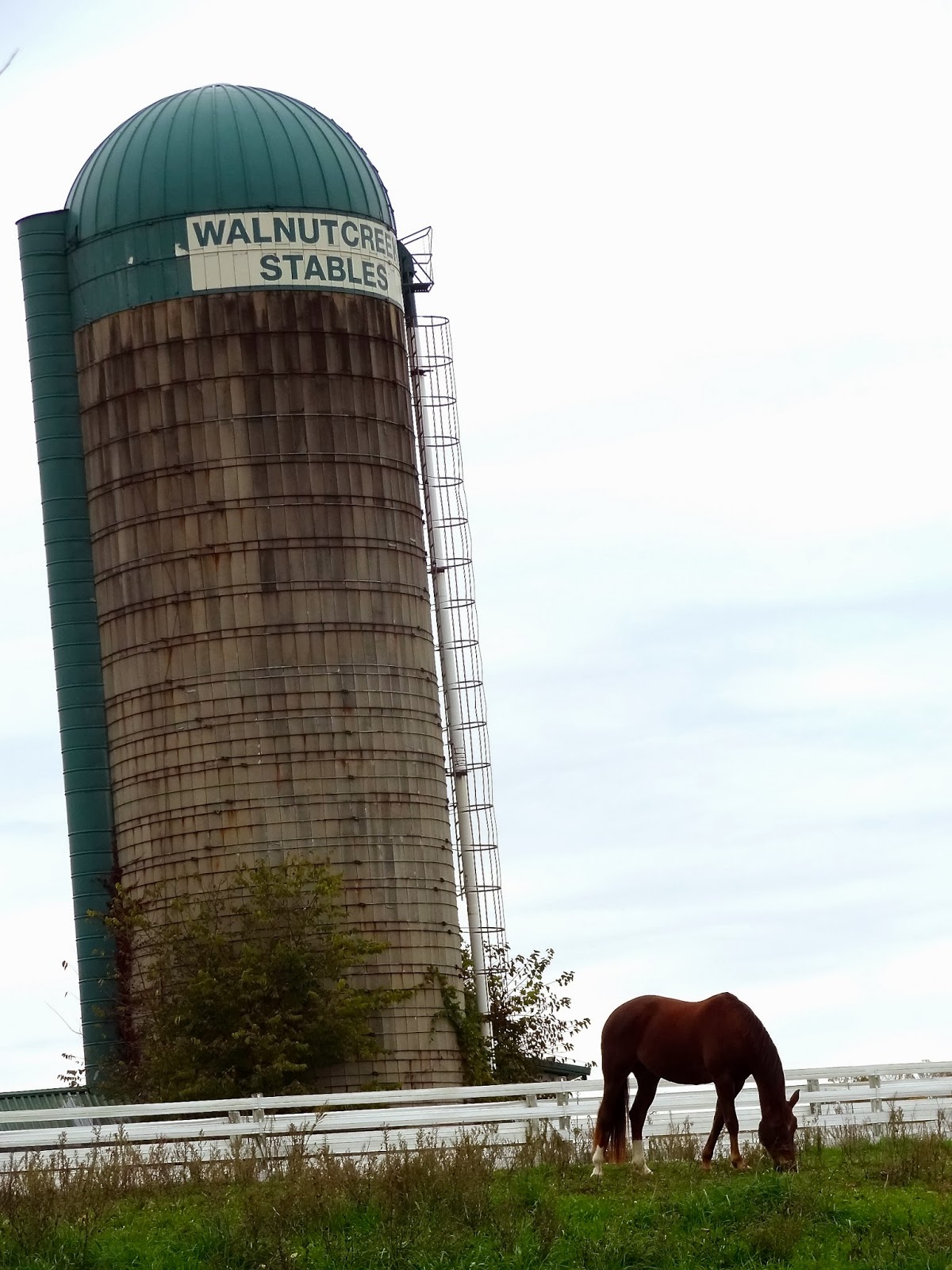
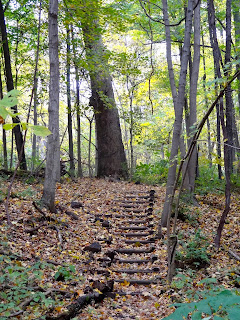
A few samples of my postage stamp this October:


I must say I don't think I will ever exhaust the idea-possibilities abundant in my corner of the
world. What about you? What's your postage stamp like, and do you draw inspiration from what you see around you?
_____________________________________

Sunday, October 20, 2013

A Poem, A Poet, and Gold Dust

view from my porch room
on a beautiful October day 
                           "Days"
              by Karle Wilson Baker

Some days my thoughts are just cocoons--
      all cold, and 
            dull, and blind,
They hang from dripping branches in the gray 
      woods of my 
            mind;

And other days they drift and shine--
       such free and flying 
            things!
I find the gold-dust in my hair, 
       left by their brushing 
            wings.

I found this poem in an old book on the shelf, One Thousand Beautiful Things (copyright 1947 :-) and thought of my friend Peggy who often drops in and encourages me with her comments. But when I posted about the hummingbird, Peggy answered with "I feel a lot like a hummingbird--beating frantically just to stay in place." When I posted about the praying mantis and asked what insect readers might draw parallels from, Peggy responded, "The worker bee--buzzing around, working like crazy, never having time to smell the roses."

And I felt the frustration behind the words. Feel it in my own writing world sometimes. Know it's in many lives. So, I post this poem to say, let's spread some gold dust around! Here's a sprinkle for you, Peggy, with hopes that the upcoming week slows down a bit so you can do some of those things you really want to do--filled with thoughts that are free and flying.

Oh, and by-the-way, who's Karle Wilson Baker anyway? I wondered about that, too, since I had never heard of her before. That's right--Karle Wilson Baker was a woman as I found out in my research. She lived from 1878-1960 and became well-known in the early 20th century as a noted poet from Nacogdoches, Texas. I immediately felt an affinity to Karle, the poet with the unusual name (for a girl) and also for the fact that I once enrolled in a novel-writing course and my instructor was from...Nacogdoches, Texas!

"Poetry came naturally to her," according to Sarah Jackson in an on-line biography (here). Her poetic styles included the lyric, sonnet, narrative, and ode. Jackson also writes that she had "a strong sense of imagery and of figures of speech, especially metaphor."

In Karle's own words in a diary entry dated 1917, she wrote: "Writing my poems is seldom more laborious than skimming the cream from my thoughts. It just needs time and quiet to rise."

Oooh, if it were only that easy, right? Well, although we might envy such a talented poet, Jackson reports that while poetry came easy, Karle's attempts at fiction did not. So she had her frustrating writing days, too!

Maybe those were the days when a girl named Karle wished that gold-dust fell from the sky, too?

Are you having cold, cocoon-thought days lately, or flying-thought days when you wear gold-dust in your hair?
________________________________

Friday, October 11, 2013

4 Writing Lessons from a Praying Mantis (and Isaac Asimov)

view from the window October 2013

"You must keep sending work out; you must never let a manuscript do nothing but eat its head off in a drawer. You send that work out again and again, while you're working on another one. If you have talent, you will receive some measure of success--but only if you persist." --Isaac Asimov

One week it was hummingbirds out our porch room window. This past week the fascination--especially for the kids, cousins aged five, three, and almost three who played practically nonstop through a four-day visit--came in the form of one of the strangest of insect creatures, the praying mantis. "Come, look!" we said. "See if you can find the praying mantis among the vines."

An up-close encounter with the praying mantis coupled with discovering the above quote (thank you, Isaac!) elicited a chuckle. Parallels popped to mind between the strange insect, the quote, and the writer's life. Bear with me :-)

1. "You must keep sending work out..." A perfect camouflage cover, our cardinal creeper vine has the same same green hue as the mantis. The stick-like figure fades from view in its tangled shoots and leaves--never to be seen unless one intentionally focuses on it. Sort of like that manuscript buried in the bottom of the file drawer.

2. "You must never let a manuscript do nothing but eat its head off in a drawer..." You do know, don't you, that the female praying mantis is known for sometimes eating the male after mating? Don't let that manuscript lay in the drawer for fear it will eat its own head off!

3. "You send that work out again and again, while you're working on another one..." The praying mantis can turn its head 180 degrees. It also can scan its surroundings with two large compound eyes and three other simple eyes located between them (fact source: National Geographic). A writer would do well to emulate a praying mantis' observation skills, both in researching markets and in working on the next project--details, details, details.

4. "If you have  talent, you will receive some measure of success--but only if you persist..." The praying mantis, named for the bent position of its front legs, suggests a prayerful pose. Ah, a little talent and persistence as Isaac Asimov says and--my addition to the equation--maybe a little prayer? For me, it's one of the most important needs of a writer since, ultimately, success is a gift to be thankful for. So my goals for the upcoming week? Get that manuscript out of the drawer. Query with persistence. Attack the WIP. Attempt a poetry prompt or two to encourage the words to come. And pray.

Lessons from a praying mantis? You bet.

Any other parallels you see? Is there an insect you take inspiration from?
______________________________